

The Paris 2024 Olympic and Paralympic Games are fast approaching. As well as the world’s best athletes, the Games are often an opportunity for showcasing technological innovation. In particular, artificial intelligence (AI) is set to play an important role in transforming experiences for spectators, athletes and organisers. We will take a look at just some of the interesting uses of AI for the Games.
Video Surveillance
The Games are expected to see in the region of 15 million spectators attending venues across the country, posing significant security challenges for organisers. The most controversial application of AI is expected to be the use of AI video surveillance. Back in 2023, French legislators passed a controversial bill permitting the use of AI video surveillance for a trial period covering the Games, thereby legalising mass video surveillance using AI for the first time in France, and also the EU.
AI video surveillance techniques will be used to analyse CCTV and drone footage captured at the venues as well as other public areas such as city streets and public transport. The aim is to allow AI algorithms to automatically detect abnormal or suspicious behaviour and provide alerts to human operators. Computer vision techniques will be used for the detection of eight different event types including abnormally heavy crowds, crowd surges, presence or use of weapons, abandoned items, fire breaking out, persons on the ground, and traffic violations. Notably, whilst AI algorithms for facial recognition have been around for some time, the use of such algorithms has been explicitly ruled out for the trial period covering the Games due to issues surrounding privacy and human rights.
Athlete Safeguarding
The International Olympic Committee (IOC) estimates that there will be around half a billion social media posts related to the Games. Whilst social media offers unprecedented opportunities for engagement between fans and athletes, it can often represent an avenue for potential abuse of athletes. The IOC plans to implement an AI monitoring service during the Games to monitor social media accounts on major social media platforms in real time to identify and flag abusive content. Using natural language processing (NLP), the monitoring service will automatically identify posts including slurs, offensive images, emojis and other phrases that could indicate abuse and flag these posts for removal by the social media platforms to thereby shield athletes and officials from online abuse. The monitoring service is expected to be in place for each of the 15,000 athletes and more than 200 officials at Paris 2024, and it is believed to be the first time that AI will provide safe online spaces for such a large number of athletes competing in so many sports at the same time.
Broadcasting
The Olympic Broadcast Committee (OBC) expects the Paris 2024 Olympic Games to result in over 11,000 hours of broadcast coverage – up from 10,200 at Tokyo 2020. The OBC and other broadcasters will use AI for various video processing tasks including, among many others, automated highlight generation and enhanced multi-camera replay services. Algorithms trained to detect key moments in sporting events will be used to analyse video footage across a number of sporting events and package these into shortened highlight reels. The OBS also plans to implement AI-enhanced multicamera replay systems at venues for events including beach volleyball, tennis, judo and rugby. These systems use video footage captured from cameras positioned around the venue to generate 3D reconstructions of scenes and enable replaying of recorded sports events from new, and potentially dynamic, viewpoints differing from those of the physical cameras at the venue.
Sports Judging and Spectating
AI systems will be used at some of the many venues to analyse video footage and enable detailed athlete and object tracking. Multi-camera systems at venues will be paired with AI systems for providing detailed information and 3D graphics to both assist decision-making by judges and enhance spectator viewing experiences. For diving events, AI will be used for generating 3D reconstructions of dives to assist judges in assessing the quality of performance. In the pole vault, athlete-to-bar separations will be automatically measured.
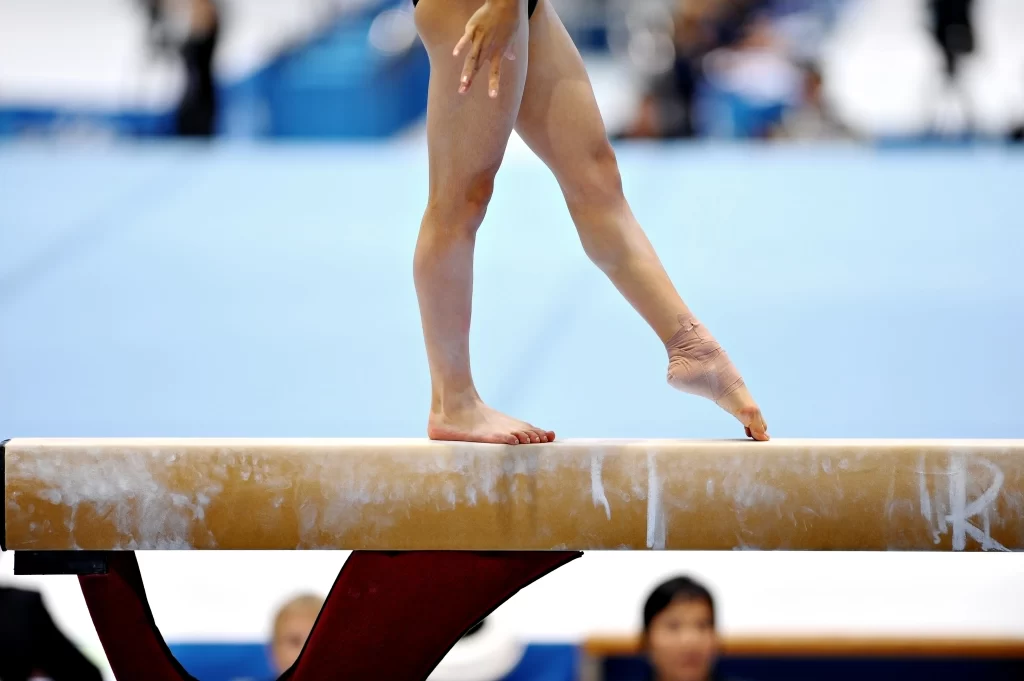
Over the years, gymnastics events have seen a number of high-profile scoring controversies which eventually led to the use of instant video replays to assist judges in handling athlete appeals. At Paris 2024, an AI judging support system (JSS) is expected to assist judges in scoring gymnastic performances. Using training data from a database of 8,000 gymnastic routines and the Code of Points defining gymnastics scoring guides, the JSS is able to match video images of gymnasts to corresponding poses and motions in the score guide. The expectation is that the JSS will provide assistance for judges whilst also potentially enabling live visualisations of scores for improving spectator experiences, with some believing that this may be the beginning of fully autonomous systems to replace human judges.
IP Protection
These are just a few of the many uses of AI at Paris 2024. Paris 2024 is set to showcase the varied and powerful applications of AI, and the increasing importance of AI in our everyday lives. Investment in IP for AI innovations is more important now than it has ever been.
There is a general misconception that AI and other software inventions are considered not patentable in the UK and Europe. Whist computer programs “as such” are excluded from patent protection in the UK and Europe, the UK and European patent offices will grant patents for some AI and other software inventions.
The European Patent Office provides various examples of patentable and non-patentable AI inventions. In Europe, patents may be granted when AI leaves the abstract realm by applying it to solve a technical problem in a field of technology. AI inventions may solve a technical problem by being directed to a specific technical application (such as classification of digital images, audio or speech signals) or a specific technical implementation of AI (i.e. one which is motivated by technical considerations of the internal functioning of a computer).
Whether AI an invention meets the requirements of patentability in the UK and Europe often requires expert analysis. The team at Forresters includes a number of patent attorneys with extensive experience in software and AI inventions. If you have a software or AI invention and would like help in securing IP protection, please get in touch with our team.

